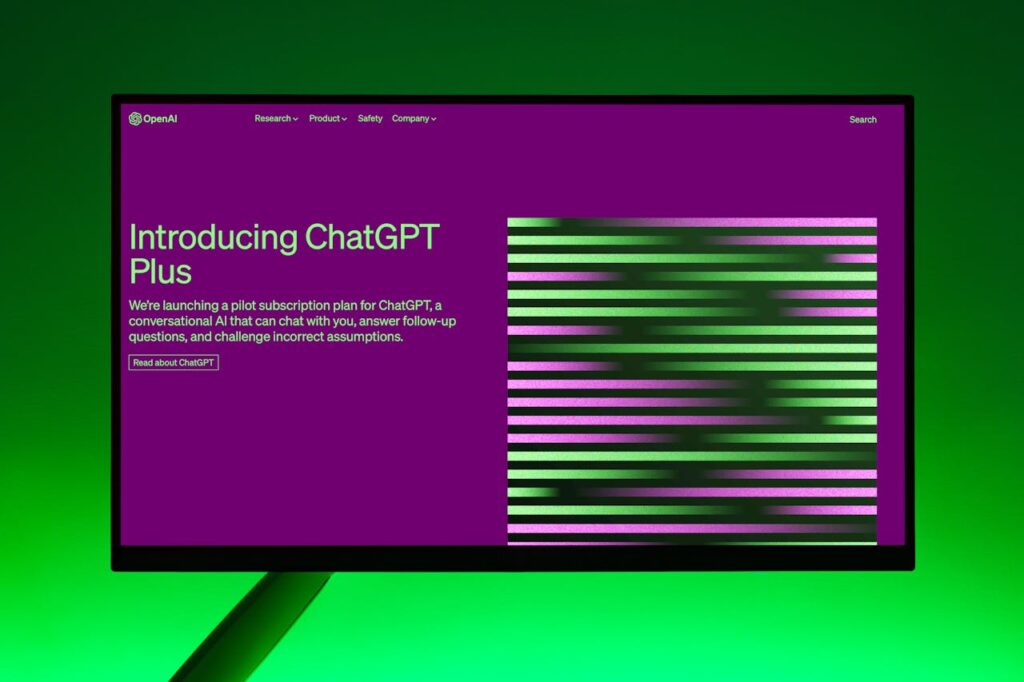
After years of Sam Altman calling advertising “a last resort,” OpenAI has reversed course: ads inside ChatGPT are now a reality. This is your complete guide to understanding what’s actually happening — and how smart businesses can move before everyone else does.
The biggest shift in advertising since Google AdWords launched
February 2026. OpenAI turns on ads inside ChatGPT. This isn’t a rumor, it isn’t a hidden beta: it’s live. Since February 9th, millions of American users on the Free and Go plans have started seeing “sponsored” placements inside conversations with the world’s most-used AI for the very first time.
If you’re a marketer, a business owner, or you manage digital presence for a company, what’s happening inside ChatGPT right now is probably the most significant shift in the digital advertising landscape in twenty years. Perhaps since 2000, when Google launched AdWords and permanently redefined the relationship between search intent and advertising.
The difference? With Google, users search. With ChatGPT, users ask. And that distinction changes everything — for advertisers, for brands, for anyone doing digital marketing, and for anyone trying to understand where advertising budgets are heading over the next five years.
In just six weeks since the US pilot launched, OpenAI reportedly generated over $100 million in advertising revenue. A signal that advertisers — despite initial skepticism — are betting on it.
How we got here: the complete timeline
Context matters. OpenAI didn’t arrive at advertising impulsively — it was a deliberate progression, moving at a speed that surprised many industry observers.
Sam Altman says no. In a Harvard interview, Altman calls advertising “a last resort” for OpenAI. The company is growing fast on subscription revenue and feels no urgency to introduce ads.
The tone shifts. On the “Conversations with Tyler” podcast, Altman admits OpenAI would “probably try ads at some point.” Fidji Simo joins as CEO of Applications — formerly of Facebook, where she oversaw one of the world’s largest advertising businesses.
Internal tests, then a pause. OpenAI tests “app suggestion cards” that resembled unlabeled ads. Negative user reaction forces a reset — and a pivot toward a full-transparency strategy.
Official announcement. Fidji Simo publishes OpenAI’s advertising principles and confirms the imminent test launch. The $8/month ChatGPT Go plan is also introduced, available in 171 countries.
Go live in the US. Ads appear for adult users on Free and Go tiers. Launch partners include Target, Adobe, Williams-Sonoma, and Albertsons. Minimum entry spend: $250,000.
The pilot is working. OpenAI reports encouraging results: no negative impact on user trust metrics, low ad dismissal rates. Expansion announced to Canada, Australia, and New Zealand.
Self-serve Ads Manager launches. OpenAI officially opens a self-service advertising platform, removing the minimum spend threshold. Agency partners include Dentsu, Omnicom, Publicis, WPP, and ad-tech firms like Adobe, Criteo, and StackAdapt.
How ChatGPT ads actually work
These aren’t banners. They aren’t pop-ups. They’re not even the classic text ads you know from Google. ChatGPT’s ad format is built on a fundamentally different architecture — and understanding it is essential before deciding whether to invest.
The format: sponsored cards below responses
Ads appear at the bottom of ChatGPT’s response, clearly labeled as “Sponsored” and visually separated from the AI-generated content. They are not embedded inside the response text — OpenAI has been absolute on this point: responses are optimized for user utility, never for advertisers.
A single ad unit can include one or more items from an advertiser. In longer conversations, the system considers the full conversational context before deciding whether and when to surface an ad.
Practical example: you’re asking ChatGPT for weekly meal-prep ideas. At the bottom of the response you might see an ad for HelloFresh or a grocery delivery service. Evaluating design software? Adobe could appear. The system matches the context of your conversation to advertiser submissions — in real time.
The targeting system: conversational contextual
Forget third-party cookies. Forget Facebook pixels and behavioral audience segments. ChatGPT uses what we might call conversational contextual targeting: the system understands what you’re talking about in real time and surfaces ads relevant to that context.
With personalization enabled, targeting can extend to previous chats and past interactions with ads. But — and this is critical — advertisers never receive your conversations, chat history, saved memories, name, email, or precise location. They only receive aggregated, anonymized performance data (impressions, clicks).
Who sees ads — and who doesn’t
| Plan | Sees ads? | Notes |
|---|---|---|
| Free | ✅ Yes | Primary target of the pilot |
| ChatGPT Go ($8/mo) | ✅ Yes | Logged-in adult users |
| Plus ($20/mo) | ❌ No | Ad-free |
| Pro ($200/mo) | ❌ No | Ad-free |
| Business / Enterprise | ❌ No | Ad-free |
| Under 18 | ❌ No | Excluded even if undeclared |
| Sensitive topics (health, politics) | ❌ No | Excluded by policy |
Why OpenAI needed ads — and why it had no choice
To understand the scale of this move, you need to start with the numbers. OpenAI exceeded $20 billion in annualized revenue in 2025 — an impressive figure, but not enough given the costs involved.
The infrastructure required to serve 800 million weekly users with a system like ChatGPT is astronomically expensive. GPUs, data centers, energy, research staff, safety teams. And OpenAI carries infrastructure commitments totaling $1.4 trillion over the coming years.
The problem? Only around 5% of users pay a subscription. The remaining 95% use ChatGPT for free — generating traffic, data, and service expectations, but zero direct revenue.
Ads solve this problem elegantly: they allow OpenAI to keep ChatGPT free (or nearly free) for hundreds of millions of people, while keeping premium tiers ad-free to protect the subscription value proposition.
It’s the same logic that drove Google, Meta, and YouTube. But with one fundamental difference: ChatGPT is where people go when they’re making decisions. They’re not passively scrolling a feed. They’re actively seeking advice, comparing options, planning purchases. For an advertiser, that’s the most valuable context that exists.
What this means for businesses: opportunity or risk?
If you run or work for a company that invests in digital marketing, you’re asking the right question: should I be there? The answer depends on your industry, your audience, and your ability to move early on new platforms.
The real opportunities — right now
- First-mover advantage: entering a nascent advertising platform early means capturing attention at lower costs before the market matures. It happened with Google Ads in 2001, Facebook Ads in 2008, TikTok in 2019.
- High-intent decisional context: ChatGPT users aren’t watching videos. They’re actively processing information and making decisions. That’s the most valuable moment for any brand.
- No keyword bidding wars: OpenAI’s contextual system eliminates the keyword auction battle. Ads appear based on conversational relevance — a more level playing field for brands that know how to articulate their value.
- Privacy by design: the tight data limitations could paradoxically increase user trust in the ads, making them feel less intrusive than the aggressive retargeting of social platforms.
- Geographic expansion imminent: Canada, Australia, and New Zealand are already in the roadmap. Europe will follow. Those building expertise now will arrive prepared.
The risks to factor in
- Nascent market with no benchmarks: CTR data is still thin and historical comparisons don’t exist. Reliable benchmarks against Google or Meta aren’t yet possible.
- Still premium-priced for SMBs: despite removal of the $50,000 floor, the platform is still optimized for brands with meaningful budgets.
- Formats still evolving: OpenAI is still learning. Rules could change. Ad formats could expand or contract based on user feedback.
- User trust to monitor closely: if ads become more intrusive, user backlash could be swift and severe — as the failed December 2025 test clearly demonstrated.
At BeeDynamic, we’ve been closely tracking the evolution of AI advertising platforms since OpenAI published its guiding principles in January. If you want a personalized analysis of how to integrate ChatGPT Ads into your digital strategy, reach out to us directly.
ChatGPT Ads vs Google Ads: it’s not a war, it’s an ecosystem
The fear many marketers share is that ChatGPT is “stealing” market share from Google. The reality is more nuanced — and more interesting.
Google generates over $200 billion a year from advertising. US AI search ad spend is projected to grow from 0.7% of all search ad revenue to 13.6% by 2029, according to eMarketer. That growth won’t all come from new budgets — it will come from the redistribution of existing ones.
But the real structural difference is this:
| Dimension | Google Ads | ChatGPT Ads |
|---|---|---|
| Targeting model | Keywords + audiences | Conversational context |
| User moment | Active search | Processing & deciding |
| Format | Text ads, display, shopping | Sponsored cards below responses |
| Pricing model | CPC, CPM, CPA | CPC and CPM (CPA in development) |
| User data for targeting | Cookies, first-party data, behavioral signals | Conversation context only (privacy-first) |
| Scale | Billions of queries/day | Hundreds of millions of users/week |
The strategic mistake would be to treat ChatGPT Ads as “just another search channel.” It’s something fundamentally different: it’s the first advertising channel native to a conversational AI context. The rules are still being written — and that is exactly when it pays to be at the table.
The self-serve Ads Manager: what we know so far
The freshest development — announced just yesterday — is the launch of OpenAI’s self-serve advertising platform. It changes the accessibility of ChatGPT ads radically.
Until a few weeks ago, joining the pilot required a minimum spend of $50,000 (later raised to $250,000 for the big-brand beta). With the self-serve Ads Manager, that barrier falls. Any business will soon be able to create and manage campaigns directly on ChatGPT through a dedicated interface.
How the Ads Manager works
The beta is currently rolling out in the US. Businesses can register as advertisers on the platform and manage campaigns in real time. Ads can be created directly through the tool or through agency partners (Dentsu, Omnicom, Publicis, WPP) and integrated ad-tech platforms (Adobe, Criteo, Kargo, Pacvue, StackAdapt).
OpenAI also announced new measurement tools to help advertisers analyze and optimize campaigns. A critical step toward platform maturity: without reliable performance data, advertisers can’t justify ongoing spend.
The pricing model has evolved: where the pilot only offered cost-per-impression (CPM), OpenAI has now added cost-per-click (CPC), allowing advertisers to align investment with a more direct performance indicator — and making the platform far more appealing to performance-focused marketers.
What businesses should do right now: 5 concrete moves
The opening of self-serve signals that the first-mover window is expanding beyond brands with six-figure budgets. Here’s how to position your business before the crowd arrives.
1. Register as an OpenAI advertiser
OpenAI has a dedicated advertiser page (openai.com/advertisers) where you can join the waitlist. Do it now, even if you don’t have a defined budget yet. Being on the list positions you for early access when the platform opens more broadly.
2. Audit your AI content visibility
Before ads, there’s a more fundamental question: how does ChatGPT present you when someone asks about your industry? Organic visibility inside AI is the new SEO. If you don’t know how you appear in ChatGPT, Gemini, or Perplexity responses, you already have a problem to fix — and the BeeDynamic team can help you with an AI visibility audit.
3. Map your “conversation moments”
ChatGPT’s contextual targeting means you need to think in terms of when and why a user talks about topics adjacent to your product or service. Map the high-intent conversational contexts you want to own: selling B2B software? Think about every conversation where someone asks for help optimizing a business workflow or comparing tools.
4. Build creative assets for the ChatGPT format
ChatGPT sponsored cards are nothing like banners. They require clear messaging, an immediate value proposition, and direct CTAs. Generic copy and clickbait headlines don’t work here — the user is in an active cognitive state and responds better to relevant, concrete messages that match their intent.
5. Adopt a test-and-learn approach from day one
Nobody has fully figured out this platform yet — not even OpenAI. The right approach is small test budgets, clear KPIs, and fast optimization cycles. Treat it the way you would have treated Google Ads in 2001: experiment, measure, scale what works.
The bigger picture: where advertising goes in the AI era
OpenAI’s move isn’t isolated. Google is integrating ads into Gemini. Microsoft already runs ads in its AI-powered Bing search. Perplexity is testing its own sponsored formats. We’re witnessing the birth of a new advertising layer — AI-native advertising — that will reshape how brands reach people over the next five years.
The dynamic is clear: the more AI becomes the primary access point for information and decisions, the more advertising budgets will follow that attention. This isn’t a hypothesis — it’s already happening with test budgets shifting from Google toward AI platforms.
For businesses, this means one thing: artificial intelligence is no longer just an operational tool — it has become a distribution channel for your commercial message. Ignoring it in your media mix over the next two years means ceding ground to whoever is investing now.
At BeeDynamic, we work every day with companies that want to understand not just how to use AI — but how to exist inside AI. How to be found, how to tell their story, how to convert within the new digital ecosystem. If you want to explore how these dynamics apply to your business, check out our AI strategy and digital marketing services or read more on our blog.
Want to be ready when ChatGPT Ads reaches Europe?
The BeeDynamic team is tracking the evolution of AI advertising closely. Let’s talk about how to position your brand before your competitors do.
Talk to us → Explore servicesAnalysis, strategy, and forward thinking on digital marketing, AI, and business growth across the DACH market and beyond.